
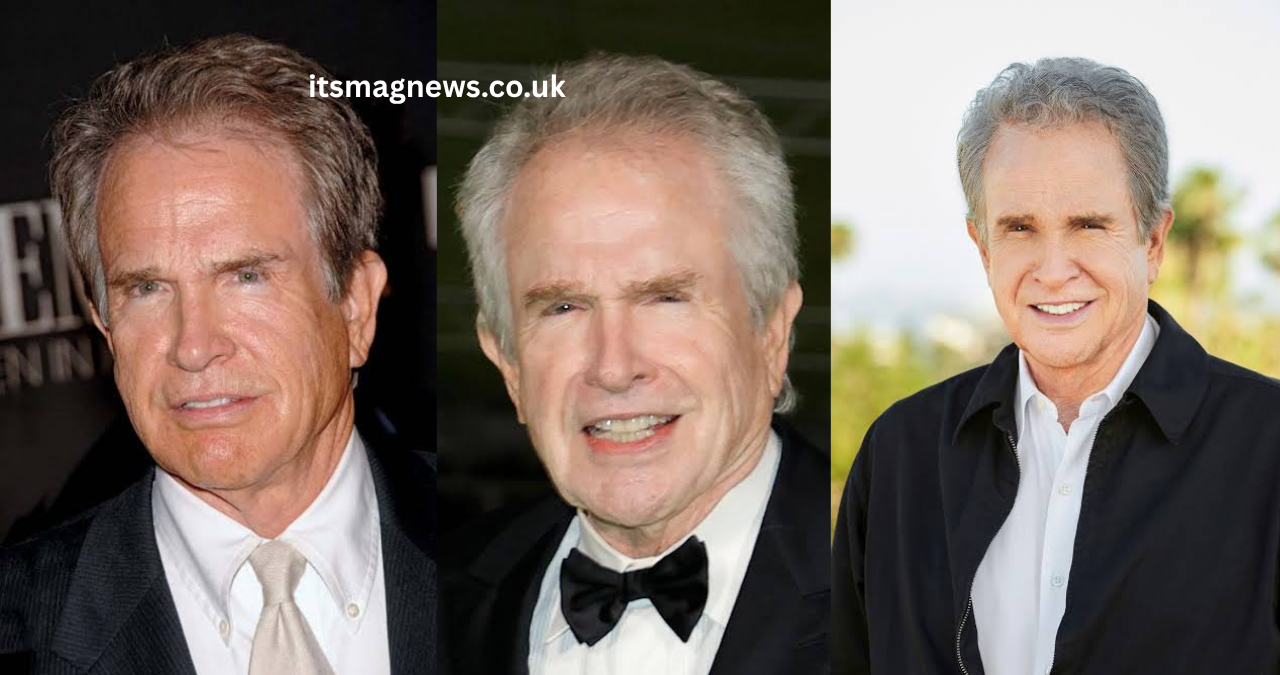

Warren Beatty is one of the most respected and influential figures in American cinema. Known for his work as an actor, director, producer, and screenwriter, he built a career that spans more than six decades. From his breakthrough in Bonnie and Clyde to acclaimed projects such as Heaven Can Wait and Reds, Warren Beatty has repeatedly taken creative risks that shaped Hollywood. His career also includes major films such as Shampoo, Dick Tracy, Bugsy, Bulworth, and Rules Don’t Apply. Beyond his professional achievements, his marriage to actress Annette Bening and his long-standing place in popular culture have kept him in the public eye.
Early Life and Family Background
Warren Beatty was born on March 30, 1937, in Richmond, Virginia. His father, Ira Owens Beaty, was an educator and administrator, while his mother, Kathlyn Corinne MacLean, was a teacher. His family had a strong connection to education and the arts, which helped shape his early interests.
Beatty grew up in Arlington, Virginia, where he became interested in both sports and performance. He was a talented football player during his school years and developed a reputation as a confident and charismatic young man.
His older sister, Shirley MacLaine, would become one of Hollywood’s most recognizable actresses. Having a successful performer in the family gave Beatty an early connection to the entertainment world, although he ultimately built a career very different from his sister’s.
After briefly attending Northwestern University, Beatty moved toward acting. He studied with respected acting teacher Stella Adler in New York City and began developing the skills that would eventually make him one of the leading stars of his generation.
Warren Beatty’s Acting Breakthrough
Warren Beatty began gaining attention in television and theater before making his major film debut in Splendor in the Grass in 1961. The movie, directed by Elia Kazan and co-starring Natalie Wood, introduced audiences to a young actor with considerable screen presence.
Beatty’s performance established him as a serious young talent. He was not simply another Hollywood leading man. His performances often combined charm, vulnerability, intelligence, and emotional tension.
During the early 1960s, he appeared in several films and quickly developed a reputation for choosing interesting roles. Rather than following the safest path available to a young star, he showed an interest in projects that allowed him to participate creatively.
That instinct became particularly important later in his career, when he moved beyond acting and became heavily involved in producing, writing, and directing.
Bonnie and Clyde Changed His Career
The defining turning point in Warren Beatty’s career came with Bonnie and Clyde in 1967. Beatty not only starred as Clyde Barrow but also served as a producer. The film, directed by Arthur Penn, became a landmark in American filmmaking.
At the time, Hollywood was going through a major cultural shift. Younger audiences wanted films that felt more modern, daring, and realistic. Bonnie and Clyde captured that changing mood with its mixture of crime, romance, violence, humor, and social commentary.
The film became a major commercial and critical success and received 10 Academy Award nominations. Beatty’s involvement as both star and producer demonstrated that he had ambitions far beyond acting.
The success of Bonnie and Clyde also helped establish a new model for Hollywood stars. Beatty showed that a leading actor could have meaningful influence behind the camera and help shape a film from development through production.
A Career Built on Creative Control
One of the most important aspects of Warren Beatty’s career is his desire for creative control. He frequently became involved in producing, writing, or directing his projects rather than simply accepting acting assignments.
This approach helped him create films with strong personalities and distinctive points of view. It also allowed him to work with major directors, writers, cinematographers, and performers while maintaining an active role in the filmmaking process.
His work during the 1970s demonstrated this growing creative independence. He appeared in Robert Altman’s McCabe & Mrs. Miller and later became involved with Shampoo, a comedy-drama that he co-wrote, produced, and starred in.
Shampoo arrived in 1975 and became another important entry in his filmography. Set against the political and social atmosphere of late-1960s America, the movie combined personal relationships with broader cultural themes.
Beatty’s ability to balance mainstream entertainment with more complicated ideas became one of the defining features of his career.
Heaven Can Wait and His Directing Career
In 1978, Warren Beatty made another major career move with Heaven Can Wait. He co-wrote, produced, directed, and starred in the film, working with Elaine May on the screenplay.
The movie was a commercial success and earned multiple Academy Award nominations. Beatty became only the second person at that time to receive Oscar nominations as an actor, director, producer, and writer for the same film.
That achievement showed how completely he had developed as a filmmaker. He was no longer simply a Hollywood actor with producing ambitions. He had become a creative force capable of managing several major aspects of a production.
Heaven Can Wait also demonstrated his ability to work within popular entertainment while maintaining an artistic identity. Its combination of comedy, romance, fantasy, and emotional storytelling helped it appeal to a broad American audience.
Reds Became His Defining Directorial Achievement
If Bonnie and Clyde established Warren Beatty as a major Hollywood figure, Reds confirmed his reputation as an ambitious filmmaker.
Released in 1981, Reds was a sweeping historical drama based on the life of American journalist and writer John Reed. Beatty directed, produced, co-wrote, and starred in the film, taking on one of the most demanding creative projects of his career.
The production was known for its scale and attention to historical detail. Beatty played Reed alongside Diane Keaton, who portrayed journalist and writer Louise Bryant.
The film received critical acclaim and earned numerous Academy Award nominations. Beatty won the Oscar for Best Director, marking the most significant Academy Award victory of his career.
Reds remains important because it showed that a major Hollywood star could use commercial influence to create an intellectually ambitious historical film. It also demonstrated Beatty’s willingness to spend years developing and completing a project rather than rushing from one production to another.
Warren Beatty and the 1980s
The 1980s brought both major successes and difficult moments for Warren Beatty. His career during this period reflected his willingness to experiment with different genres and styles.
One of the most notable films was Ishtar, the 1987 comedy directed by Elaine May and starring Beatty alongside Dustin Hoffman. The film became famous for its troubled production and disappointing commercial performance.
Despite the setback, Beatty continued working on ambitious projects. He did not allow one unsuccessful film to define his career.
His ability to recover from criticism became another important part of his professional story. Hollywood careers often depend on long-term consistency rather than a perfect record, and Beatty’s later work proved that he remained capable of producing major films.
Dick Tracy Brought a New Kind of Stardom
In 1990, Warren Beatty returned to the spotlight with Dick Tracy. Based on the classic comic strip, the film featured Beatty as the famous detective and included Madonna, Al Pacino, Dustin Hoffman, and other major performers.
The movie stood out for its bold visual style. Its strong colors, comic-book-inspired design, costumes, and theatrical presentation gave it a distinctive identity.
Dick Tracy also became an important example of Beatty’s ability to turn a recognizable property into a major Hollywood production. The movie earned several Academy Award nominations and won three Oscars, including awards for art direction, makeup, and original song.
The film remains one of the most recognizable projects in his filmography.
Bugsy and Another Oscar-Nominated Performance
Beatty returned to serious drama with Bugsy in 1991. Directed by Barry Levinson, the movie explored the life of gangster Benjamin “Bugsy” Siegel.
Beatty served as both star and producer, while Annette Bening played Virginia Hill. Their professional relationship soon developed into a personal relationship, eventually leading to marriage.
Bugsy received nine Academy Award nominations, including Best Picture and Best Actor for Beatty. Although he did not win the acting award, the nomination reinforced his position as one of Hollywood’s most accomplished performers.
The film also marked an important moment in Beatty’s personal life because his relationship with Bening became one of the most enduring partnerships in the entertainment industry.
Warren Beatty and Annette Bening
Warren Beatty married actress Annette Bening in 1992. Their marriage attracted considerable attention because both were highly successful performers with established careers.
Unlike many celebrity relationships that fade quickly under public pressure, their marriage has lasted for decades. They have four children: Stephen, Benjamin, Isabel, and Ella.
Their family life has generally remained more private than the intense media attention Beatty received during his younger years. His marriage to Bening also became a major shift in the public image surrounding his personal life.
Bening continued to build an acclaimed acting career, while Beatty became more selective with his own film projects. Together, they have remained one of Hollywood’s longest-lasting celebrity couples.
Later Films and Bulworth
In 1998, Warren Beatty returned to filmmaking with Bulworth, a political satire that he directed, co-wrote, produced, and starred in.
The movie followed a fictional politician who begins speaking honestly instead of using traditional political language. Its story combined comedy with commentary about American politics, media culture, race, money, and elections.
Bulworth demonstrated that Beatty was still interested in challenging subjects. He used comedy to explore issues that could otherwise become difficult or overly serious.
The film also showed that his filmmaking interests had not become limited to nostalgia or traditional Hollywood entertainment. He continued using cinema as a way to examine American society.
Rules Don’t Apply and His Return to Film
After Town & Country in 2001, Beatty became much less active in feature filmmaking. Unlike many actors who appear in multiple productions each year, he preferred to wait for projects that interested him creatively.
His return came with Rules Don’t Apply in 2016. Beatty wrote, directed, produced, and starred in the romantic comedy, playing billionaire Howard Hughes.
The film included a younger generation of performers as well as established stars. Its release reminded audiences that Beatty remained interested in writing and directing even after decades in Hollywood.
His selective approach also contributed to the sense that every new Warren Beatty project was an event. Because he appeared less frequently, audiences often paid closer attention when he returned to the screen.
Warren Beatty’s Acting Style
A major reason Warren Beatty remained successful for so long is his distinctive screen presence. Early in his career, he was known for his youthful appearance and charisma, but his acting developed considerably over time.
He could play romantic leads, morally complicated characters, comic figures, political personalities, and historical figures. His performances often carried an element of confidence, but he was also capable of portraying insecurity and emotional conflict.
Beatty’s screen persona worked especially well in stories about ambitious men facing personal or political pressure. His characters frequently wanted more from life and were willing to challenge established rules to get it.
That quality connected many of his performances, even when the movies themselves were very different in tone.
Warren Beatty as a Producer and Filmmaker
Beatty’s influence extends beyond his acting credits. His work as a film producer helped him shape projects that might have looked too risky from a traditional studio perspective.
His involvement with Bonnie and Clyde, Heaven Can Wait, Reds, Dick Tracy, and Bugsy demonstrates his long-term commitment to filmmaking.
He also developed a reputation as a perfectionist. Reports about his filmmaking process often emphasize his attention to detail and willingness to spend significant time refining scenes.
While that approach could make productions more complicated, it also contributed to the distinctive quality of many of his films.
Warren Beatty’s Awards and Recognition
Throughout his career, Warren Beatty has received major recognition from the Academy Awards and other film organizations.
His Oscar history reflects his unusual range of responsibilities. He has been recognized for acting, directing, writing, and producing.
His most important Oscar victory came for directing Reds at the 1982 Academy Awards. The film also received awards for supporting actress and cinematography.
Beatty’s achievements are significant because relatively few Hollywood figures have reached the highest level in so many different filmmaking roles.
His legacy is therefore not based only on the number of successful movies he appeared in. It is also based on his influence behind the camera.
The Cultural Impact of His Career
Warren Beatty became famous during one of the biggest transitions in American film history. The Hollywood studio system was changing, younger filmmakers were gaining influence, and audiences were becoming more interested in movies that reflected contemporary culture.
Beatty understood that shift early. Instead of relying solely on traditional star power, he became involved in the creative process.
His career helped establish the idea of the actor-producer-director as a powerful figure in Hollywood. Many later performers followed similar paths, using their popularity to gain greater control over their projects.
His films also frequently explored topics such as politics, relationships, ambition, fame, and social change. That combination of entertainment and commentary remains central to his reputation.
Warren Beatty’s Legacy in American Cinema
The lasting legacy of Warren Beatty comes from his ability to move between different roles. He could lead a movie as an actor, shape it as a producer, write its screenplay, and direct it.
Few Hollywood stars have maintained that level of creative involvement across such a long career.
His most celebrated films remain important examples of American filmmaking. Bonnie and Clyde helped redefine the crime movie. Heaven Can Wait showed his skill with sophisticated comedy and fantasy. Reds established his strength as a director. Dick Tracy demonstrated his ability to create visually striking mainstream entertainment, while Bulworth reflected his interest in political satire.
Together, these films reveal a career driven more by curiosity and creative ambition than by a simple desire to remain constantly visible.
Why Warren Beatty Still Matters
Warren Beatty remains an important figure because his career represents a unique period in Hollywood history. He rose to fame as a charismatic young actor but gradually became one of the industry’s most influential actor-filmmakers.
His willingness to take creative control helped change expectations for major movie stars. He showed that an actor could have a powerful voice in decisions involving scripts, production, directing, and the overall direction of a film.
At the same time, his career demonstrates the risks of creative independence. Not every project succeeded, but Beatty consistently returned to challenging material rather than simply repeating the formula that made him famous.
That combination of ambition, risk, and longevity is what makes his career stand out.
Conclusion
Warren Beatty has built a remarkable career by refusing to remain in a single role. He began as a promising young actor and developed into a respected producer, screenwriter, and director. His work on Bonnie and Clyde changed the direction of his career, while Heaven Can Wait and Reds established his creative authority.
His later projects, including Dick Tracy, Bugsy, Bulworth, and Rules Don’t Apply, showed that he continued to take risks and explore different forms of storytelling. His marriage to Annette Bening and his enduring place in American popular culture have added another dimension to his public legacy.
More than six decades after his film debut, Beatty remains a defining figure in Hollywood history. His combination of star power and creative control helped shape modern American cinema, and his most important films continue to attract audiences and filmmakers who recognize the lasting impact of his work.