
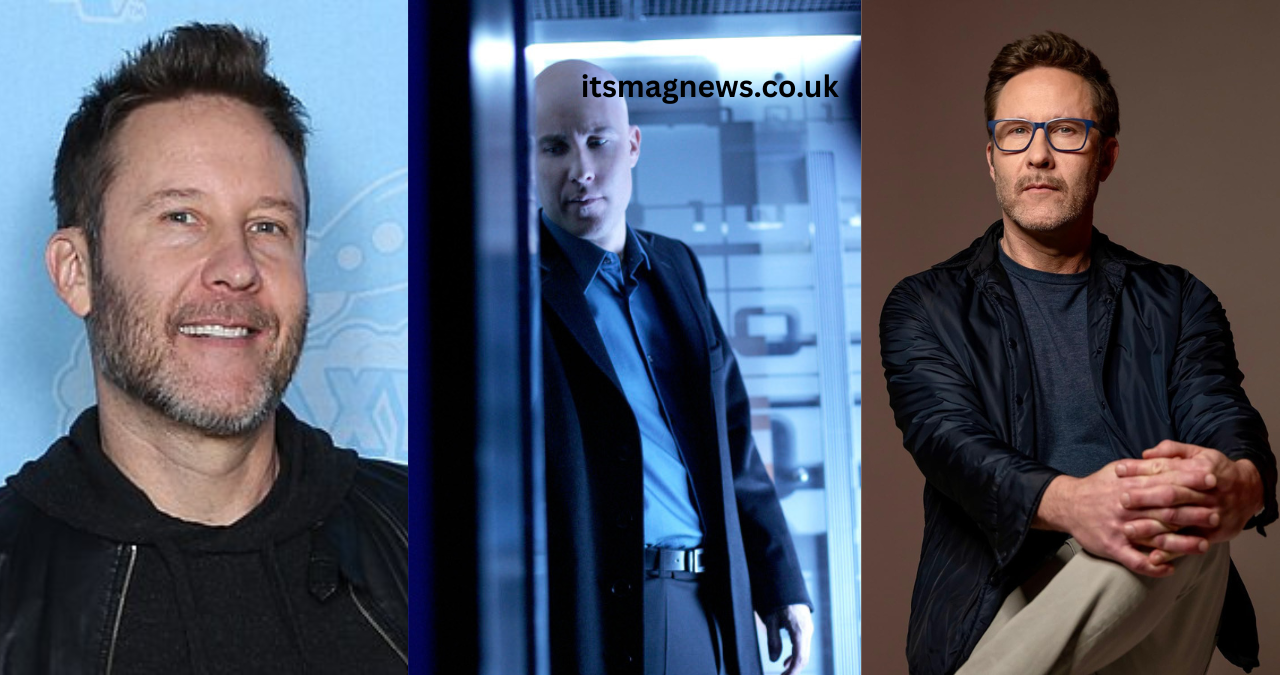

Michael Rosenbaum has built a lasting career across television, film, animation, comedy, music, and podcasting. For many American viewers, Michael Rosenbaum is best known for playing Lex Luthor in Smallville, where his performance gave the famous DC villain a more personal and complicated side. His career, however, extends far beyond that iconic role. He has worked as an actor, director, producer, writer, voice performer, musician, and podcast host.
Born on July 11, 1972, in Oceanside, New York, Rosenbaum grew up in Newburgh, Indiana, before studying theater at Western Kentucky University. He later moved to New York City to pursue acting. Over the years, his work has taken him from teen comedies and horror films to major superhero productions and animated series.
Michael Rosenbaum and His Early Acting Career
Before becoming a familiar face to superhero fans, Michael Rosenbaum spent several years building experience through television and film. His early work included appearances in productions such as The Tom Show and Zoe, Duncan, Jack & Jane. These projects helped him develop the timing and personality that would later become important parts of his screen presence.
His film career also began taking shape during the late 1990s. One of his early recognizable movie appearances came in Urban Legend, a popular teen horror film from 1998. He continued working steadily while exploring different genres, including comedy and drama.
This early period was important because Rosenbaum did not immediately become associated with one character or one type of performance. Instead, he gained experience across several formats. That versatility later allowed him to move comfortably between live-action roles, comedy, dramatic scenes, and voice acting.
Michael Rosenbaum as Lex Luthor in Smallville
The defining moment of Michael Rosenbaum career arrived in 2001 when he joined Smallville as Lex Luthor. The series explored Clark Kent’s life before he became Superman, giving Rosenbaum an opportunity to portray Lex as more than a traditional comic-book villain.
His version of Lex was intelligent, charming, ambitious, vulnerable, and increasingly dangerous. The relationship between Lex and Clark became one of the show’s central dramatic elements. Their friendship began with genuine affection, but their different values and choices gradually pushed them toward conflict.
Rosenbaum’s performance helped make Lex one of the most memorable characters in the series. He appeared in 154 episodes, serving as a main cast member during the show’s early seasons and returning for the series finale in 2011.
What made the performance especially effective was its emotional range. Rosenbaum could play Lex as a friendly and confident businessman in one scene and reveal insecurity or manipulation in the next. That balance gave the character depth and made his eventual transformation more believable.
His work on Smallville also earned major recognition. He won the Saturn Award for Best Supporting Actor in a Television Series in 2002 and received additional award nominations during his time on the show.
Why His Lex Luthor Remains So Popular
The popularity of Rosenbaum’s Lex Luthor comes partly from the way Smallville approached the character. Instead of presenting him as an established supervillain from the beginning, the series showed his development over time.
Viewers saw his relationship with his father, his complicated friendship with Clark, and his struggle to define his own identity. This approach created a character who could be sympathetic in one storyline and frightening in another.
Michael Rosenbaum also brought natural humor to the role. His performance did not rely entirely on dramatic intensity. Small moments of sarcasm, confidence, and awkwardness made Lex feel more like a real person.
That combination helped establish his portrayal as an important interpretation of the character. Even years after Smallville ended, fans continue to discuss his version of Lex Luthor and compare it with other live-action portrayals.
Michael Rosenbaum and His Voice Acting Career
While Smallville made him famous among live-action television audiences, Michael Rosenbaum also developed an impressive career in animation. His voice work demonstrated a different side of his talent because he could create recognizable characters without relying on his appearance.
One of his most important voice roles was Wally West, also known as The Flash, in the DC animated universe. He voiced the character in Justice League and Justice League Unlimited, along with appearances in related animated productions.
His work as The Flash became especially popular with animation fans. The character allowed Rosenbaum to use a faster, more playful style than the controlled intensity he often brought to Lex Luthor.
He also contributed voice performances to projects such as Static Shock, Teen Titans, Batman Beyond, Jackie Chan Adventures, and other animated productions. His voice acting became an important part of his career rather than simply an extension of his live-action work.
The Flash and His DC Connection
Rosenbaum’s connection with DC characters is unusual because he became strongly associated with both a major villain and a major superhero. Playing Lex Luthor in Smallville and voicing The Flash gave him two very different positions within the DC universe.
As Lex, he relied heavily on subtle expressions, body language, and dialogue. As The Flash, his voice carried much of the personality. The contrast shows why his career has remained interesting to comic-book audiences.
His animated superhero work also helped him establish credibility among fans who may have first discovered him through Smallville. For many viewers, hearing his voice as Wally West became almost as recognizable as seeing him as Lex.
Michael Rosenbaum Beyond Smallville
After leaving Smallville, Rosenbaum continued to explore different roles rather than trying to recreate the same success. He appeared in films including Hit and Run, The Neighbor, Father of Invention, and Sorority Boys. He also continued working in television and independent productions.
In 2014, he directed and appeared in Back in the Day, demonstrating his interest in filmmaking beyond acting. His work behind the camera reflects another part of his career that is sometimes overlooked when discussions focus only on Lex Luthor.
He later took the leading role of Buddy Dobbs in the television comedy Impastor. The series gave him an opportunity to move away from the serious superhero image that had become closely connected with his career.
That shift was useful creatively. Comedy allowed Rosenbaum to show a lighter and more unpredictable performance style while proving that his abilities were not limited to dramatic or comic-book roles.
Michael Rosenbaum in Guardians of the Galaxy
Rosenbaum eventually became part of the Marvel Cinematic Universe through his role as Martinex in Guardians of the Galaxy Vol. 2. He later reprised the role in Guardians of the Galaxy Vol. 3.
The Marvel connection was notable because Rosenbaum had already become closely associated with DC through Smallville and his animated superhero work. Appearing in a major Marvel franchise gave fans another reason to follow his career.
Martinex is a member of the Ravagers and appears alongside the larger ensemble of characters connected with the Guardians universe. Although the role is very different from Lex Luthor, it continued Rosenbaum’s connection with major superhero entertainment.
For longtime viewers, seeing him in a Marvel production was also a reminder of how far his career had developed since his early television appearances.
Michael Rosenbaum and Inside of You
One of the most interesting changes in Rosenbaum’s career came when he moved deeper into podcasting. In 2018, he launched Inside of You, a long-form interview podcast focused on conversations with actors, musicians, comedians, athletes, and other public figures.
The podcast has a different tone from a typical promotional celebrity interview. Rosenbaum often focuses on personal experiences, career challenges, insecurity, failure, relationships, creativity, and the realities behind public success.
That approach has helped Inside of You develop its own identity. Instead of simply asking guests about their newest projects, Rosenbaum often tries to understand the person behind the public image.
The format also suits his personality. After spending years performing scripted characters, he can use podcasting to have longer and more spontaneous conversations.
Talkville and the Smallville Reunion
Rosenbaum later returned to his Smallville roots through Talkville, a podcast created with his former co-star Tom Welling. The two began the show in 2022 and use it to revisit episodes of the series.
For fans, Talkville offers a chance to hear behind-the-scenes stories and reflections from two people who were directly involved in the production. It also provides a fresh way to experience older episodes.
The podcast demonstrates how strong the connection remains between Rosenbaum, Welling, and the Smallville fan community. More than a traditional retrospective, it allows the actors to look back at the decisions, performances, and memories associated with the series.
Michael Rosenbaum as a Musician
Acting and podcasting are not Rosenbaum’s only creative interests. He is also involved in music as the lead singer of Sun Spin, a band formed with his friend Rob Danson.
Sun Spin released its first album, Best Days, in 2021. The band later continued releasing music, showing that Rosenbaum’s creative interests extend beyond television and film.
Music provides another outlet for his personality. Unlike acting, where the performer interprets someone else’s character, being part of a band allows Rosenbaum to contribute more directly to the creative process.
This combination of acting, comedy, podcasting, and music helps explain why his career has remained active across different entertainment platforms.
The Lasting Impact of His Career
The most interesting part of Rosenbaum’s career is its range. He is strongly associated with Lex Luthor, but that role represents only one part of his professional identity.
His work includes live-action television, feature films, animation, superhero franchises, directing, producing, music, and podcasting. Few actors maintain such a broad creative path while remaining closely connected to fans from an earlier generation.
His career also demonstrates the value of reinvention. Rather than depending entirely on the popularity of Smallville, Rosenbaum continued looking for different ways to work. He moved into comedy, independent filmmaking, Marvel projects, music, and long-form interviews.
For fans discovering him today, his filmography offers more than a single iconic performance. It provides a view of an entertainer who has repeatedly experimented with different formats while maintaining a strong connection with his audience.
What Makes Michael Rosenbaum Stand Out?
Rosenbaum’s biggest strength may be his ability to make very different characters feel natural. His Lex Luthor was controlled and calculating, while his Flash was energetic and humorous. His comedy performances show another side of his personality, and his podcast work presents him as a conversational host rather than a scripted performer.
His career also benefits from authenticity. Whether discussing acting, personal experiences, music, or old Smallville memories, he tends to bring a relaxed and conversational approach to his work.
That quality has helped him remain relevant even as the entertainment industry has changed dramatically. Television audiences moved toward streaming, superhero franchises expanded, and podcasts became a major part of popular culture. Rosenbaum found ways to participate in each of those shifts.
Michael Rosenbaum’s Place in Pop Culture
For American pop-culture audiences, Rosenbaum remains particularly significant because Smallville helped shape a generation of superhero television. The show arrived before the modern superhero television boom reached its current scale, and its long run helped establish that audiences would follow character-driven stories connected to comic-book mythology.
Rosenbaum’s Lex Luthor was central to that success. His interpretation gave viewers a human perspective on one of Superman’s most recognizable enemies.
At the same time, his voice performance as The Flash created another lasting connection with DC fans. His Marvel appearance as Martinex then expanded his superhero legacy into another major franchise.
Today, his podcasts provide an entirely different connection. Instead of being recognized only through fictional characters, audiences can hear Rosenbaum speak directly with other entertainers about real experiences.
Conclusion
Michael Rosenbaum has created a career that reaches far beyond his most famous role. His portrayal of Lex Luthor made him a recognizable name among superhero fans, while his voice work as The Flash established another important connection with DC audiences.
His later work in Marvel productions, comedy, music, filmmaking, and podcasting shows his willingness to keep evolving. From Smallville to Guardians of the Galaxy, and from animation to Inside of You and Talkville, Rosenbaum has continued finding new ways to entertain and connect with audiences.
That ability to move between characters, genres, and creative formats is what makes his career stand out. For longtime fans and newer viewers alike, his body of work offers a compelling example of how an actor can turn one iconic role into a much broader and lasting entertainment career.